iNForm your Transition to Adult Services
Please note: this new page is a work in progress and is still being updated.
Transition is the process of moving your care from children’s to adult's services. It is an extremely important process as growing up means you will take control of your healthcare needs.
Transition refers to the full process, including the initial planning, the actual transfer between children's and adult's services, and the support you should receive throughout the whole process.
We considered providing a comprehensive guide to transition a few years back, but after careful consideration and after talking with various hospital units across the country, we felt that this would not be very practical or very helpful, as every regional paediatric department has their own internal guidelines and practices. If we insisted on a UK-wide approach, it would not necessarily be helpful as it may cause tensions. Since you need to work closely with your own care providers, you need everything to be friendly, and to work together with your local hospital in a positive way.
We therefore feel it will be more useful for us to educate you, your families, and your carers, on what basic level of support you should expect to receive, as well as how our team of Nerve Tumours UK Specialist NF Nurses and Advisors can support you and your family throughout your transition journey.
Obviously, we have taken into consideration the guidelines set out by NICE, the National Institute for Health and Care Excellence, for transition. You can read them by clicking the button below.
Learning to manage your NF
What to expect
Not all people are the same. Some of us are good at reading, while others are good at sport. After all, the world would be a very boring place if we were all the same!
Therefore, your transition journey should be suited to you and your needs, and your healthcare provider must make sure that the support you receive meets these needs.
Considerations
You and your nurse need to discuss how best you will manage your condition, and so they need to discuss:
- your maturity, as the age at which you transition to adult services can vary
- your cognitive and learning abilities
- if you need mental health support
- any problems you experience with your NF
- your family and personal circumstances
- who looks after you
- how you prefer to communicate
Planning ahead
Your healthcare team should start planning for your transition to adult medical services from school year 9 (when you are aged 13 or 14) at the latest. For any young people with education, health and care plans, this must happen from school year 9.
Any support must be the right support for you, so we need to make sure that:
- it's based on your abilities and strengths
- the plan is a useful and workable one
- it is not a 'pre‑determined' set plan, because everyone is different!
- it clearly shows and identifies the type of help and support that can and should be provided for you, which also includes the support that Nerve Tumours UK can offer to you and your family or carers
Our support is wide-reaching and gives you access to our team of regional nurses, the National Helpline, online support groups and all of our downloadable literature.
If there is any information you need that is not on hand, contact us and we will find out for you.
Parents and carers
Although it is better for young people to take charge of their own healthcare requirements as they grow up and become more confident, we do realise how daunting this can be for many.
So we will always welcome your parents and carers to be part of this process, but we will only ever talk to them if that is what you want. It is really important that you tell your healthcare providers if you would like others involved in your planning chats.
Safeguarding
We have to make sure you and all young people are safe. All healthcare workers involved in supporting you through transition are responsible for sharing safeguarding information with other organisations in line with local information sharing and confidentiality policies.
We are able to provide a copy of our policy if this would be helpful.
Your voice
Young people are the most important voice in this transition journey, so the Specialist NF Nurses and Advisors, who are all qualified medical professionals, will:
- treat all of you with respect and as an equal partner in the process
- listen to you and take a full account of your views and needs
- involve you and your family or carers
- liaise with your GP (if needed)
- support you to make decisions and build your confidence so you can manage your own care in the years to come
- fully involve you in all decision making and plans
Topics you should talk about
Here is a list of some of the topics that your care team should talk to you about and the topics that should be looked into during the transition process.
The Specialist NF Nurses and Advisors will cover all important topics, such as:
- a full explanation of your ongoing medical needs
- your emotional requirements
- relationships
- contraception and family planning
- education and/or employment, as well as how we can further help in these areas
- the benefits system
Your condition
Some of you will currently be looked after by the Complex Teams based in St Mary's Hospital in Manchester and Guy's and St Thomas' Hospital in London, by the NF2 service, or by local paediatric units, while others may be under the care of the Nerve Tumours UK Team of Specialist NF Nurses.
Your current healthcare professional will liaise with the teams in adult's services to ensure a smooth transition depending on your needs.
Complex NF1
[Information to follow].
Non-complex NF1
Your local paediatrics units, or our team of Specialist NF Nurses, will liaise directly with your GP to ensure they are fully briefed about your condition and your medical history. They will advise the level of care that you require going forwards.
On some occasions it may be necessary to prolong your stay under paediatric services, but this is nothing to worry about as it happens often and will be managed locally.
You may find this guide easy to use when explaining your condition to others.
NF2
Not all NF2 services operate in the same way, and the following is currently under review across them, but this is a sample letter of what you might expect to receive when you reach transition age.
...and topics you will need to think about and discuss at various ages.
Managing your healthcare
To manage your healthcare effectively, you need to be aware of what help is out there.
Here are some more useful contacts and resources, particularly for teenagers, compiled by Dr. Shruti Garg, Clinical Senior Lecturer in Translational Child Psychiatry at the University of Manchester, Honorary Consultant Child and Adolescent Psychiatrist at the Royal Manchester Children’s Hospital, and Member of the Nerve Tumours UK Medical Advisory Board.
Nerve Tumours UK
Whenever you need us, we will be there to support you.
Always remember that we will take any question that you have seriously. No question is ever too small or too daft!
We want to equip you with the ability and tools to build confidence and independence, so you can take charge of your healthcare.
Information leaflets
As well as our regional Specialist Nurses and Advisors, we offer a host of downloadable leaflets for you to look at, and you can always talk to Specialist NF Nurses on our helpline.
Nerve Tumours UK Helpline
Remember: if you have questions, you can call the Nerve Tumours UK Helpline at any time during the transition process. No question is ever too silly!
NTUK Helpline
Nerve Tumours UK Specialist NF Nurse and Advisor-led clinics
These clinics are available in some regions to help with ease of transition. Ask if these are available in your area, or book an online meeting with the Nerve Tumours UK Helpline team.
Easy to understand
Our Specialist NF Nurses and Advisors agree to always speak in a clear simple manner, while all downloadable leaflets are written in a clear, easy to read, concise format. But please remember: we are here to help, so feel free to ask us any questions you need answers to!
Thinking of going to university or college?
You might find the information in our university guide useful.
iNForm your university
Find out more
Useful links
Helpful charities
We are linked to many other helpful charities that will help you make your way through the education, employment and benefits systems.
Find out more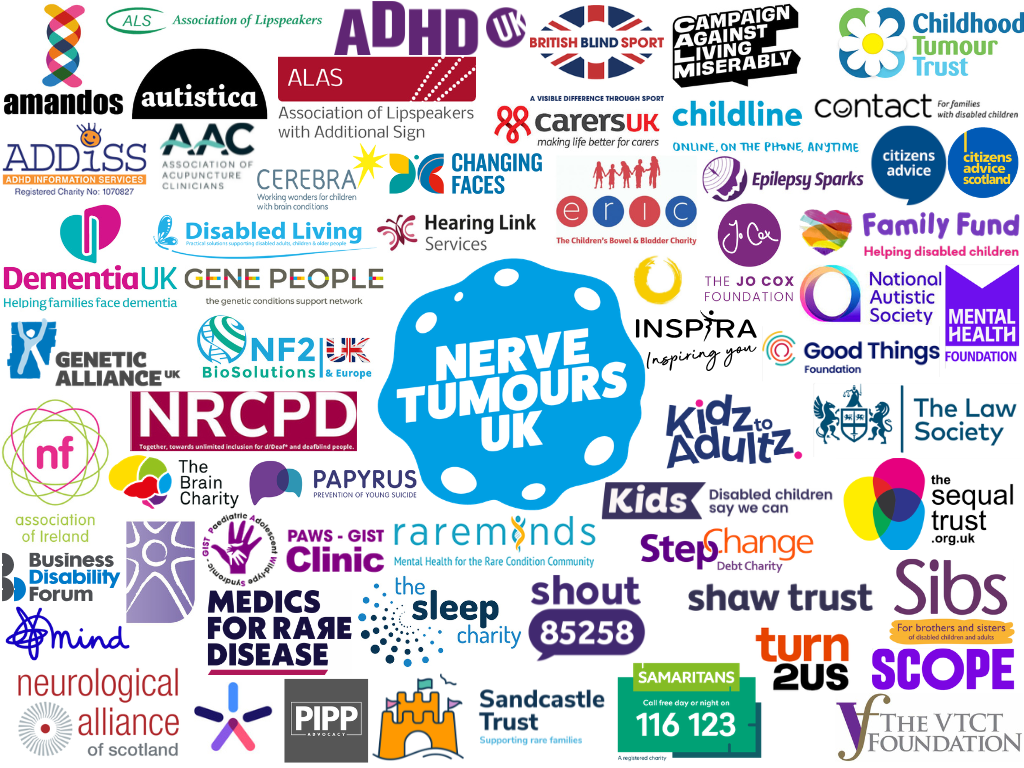
Community support groups
We also run closed community support groups for you to talk to each other.
Find out more

iNForm your GP
Help us reach out to medical professionals and create a chain of information for those affected by the condition.
Find out more
iNForm your Workplace
Help us make sure employers are able to create a supportive environment for their employees with NF.
Find out more