07 September 2026
NF is Part of Her Story, Not the Whole Story
"I don't want it to get rid of my NF. I like having NF."
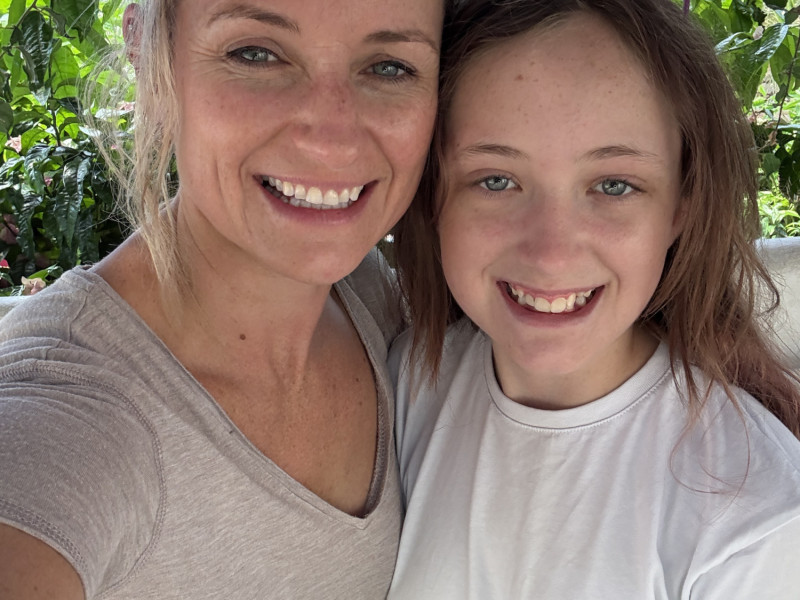
Those weren't the words I expected to hear from my twelve-year-old daughter.
She said them while taking part in a research study for children with Neurofibromatosis Type 1 (NF1), and they stopped me in my tracks. As her mum, every instinct has always been to wish this condition away. To protect her from the uncertainty, the hospital appointments and the challenges that come with it.
But Tora wasn't talking about the medical condition. She was talking about herself.
NF is part of who she is, but it isn't who she is. And perhaps that's the biggest lesson our family has learnt over the past twelve years.
When Tora was just a few weeks old, I noticed a single café-au-lait patch on her leg. As a GP, I recognised it as a possible early sign of NF. We were reassured it was probably nothing and even given antifungal cream "just in case". I remember crying as I applied that cream because, deep down, I knew it wasn't a fungal infection.
A few months later another café-au-lait patch appeared, and I pushed for a genetics referral. Almost a year later I stood by the living room window taking the call from the geneticist. Professionally, I spoke doctor to doctor. Emotionally, I was hoping they would tell me I had been wrong.
They didn’t.
As soon as I put the phone down, I cried.
As doctors, we understand genetics, probabilities and clinical pathways. Living with a diagnosis as a parent is entirely different. Suddenly it isn't a condition in a textbook. It's your child and an uncertain future.
Like many parents, I turned to Google. Every evening became another research paper, another forum and another worst-case scenario. I thought knowledge would bring reassurance. Instead, it left me exhausted.
Then I found Nerve Tumours UK.
I still remember speaking to Rosemary, one of the Specialist NF Advisors. She didn't dismiss my fears or make unrealistic promises. She simply listened, understood and helped me see beyond the diagnosis. That conversation marked the point where I stopped focusing on everything that might happen and started focusing on helping Tora live well.
Over the years, NF has become part of our normal. There have been MRI scans, ophthalmology appointments, physiotherapy, occupational therapy, speech and language therapy, and more hospital visits than I can remember. At one stage Tora was under nine different specialties. Thankfully, her optic pathway glioma has remained stable and her vision has been preserved.
Ironically, the biggest challenges haven't been the tumours.
For Tora, dyspraxia, dyslexia and dyscalculia have had the greatest impact on everyday life. School requires far more effort than people realise. As she's grown older, she's also become more aware of being different and has sometimes felt isolated. As a parent, those moments are often much harder to witness than any hospital appointment.
Yet despite it all, Tora continues to surprise me.
She has what she calls her own "aesthetic". She'll happily wear sunglasses indoors, create outfits nobody else would think of and has never been particularly interested in following the crowd.
One day another child made a comment about her NF. Before I had time to respond, Tora smiled and said, "That sounds like a you problem, not a me problem.” I couldn't have written a better response myself.
People often think resilience looks extraordinary. Living with NF has taught me that it usually looks much quieter. It looks like getting up for school when learning feels harder than it does for everyone else. It looks like another hospital appointment, another scan, another challenge, and simply carrying on.
Being both a GP and Tora's mum has also changed how I think about healthcare. Medicine rightly focuses on diagnosing and treating disease, but living with a lifelong condition has reminded me that health is much bigger than medicine alone. Confidence, purpose, relationships, movement, sleep and emotional wellbeing all shape how we experience our lives. That understanding led me towards lifestyle medicine and strengthened my belief that, while we can't always change a diagnosis, we can help people live well alongside it.
Earlier this year, Tora took part in a research study in Manchester investigating transcranial current stimulation to support learning and memory in children with NF1. Watching her volunteer made me incredibly proud and reminded me how important research is for the future of families living with NF. I often think back to the sentence that opened this article.
"I don't want it to get rid of my NF."
As a mother, I would still take this condition away in a heartbeat if I could. But I also understand what she meant. She doesn't see herself as broken. NF is one chapter of her story, not the title of it.
I'm incredibly grateful to Nerve Tumours UK, to Helen Swann, our Specialist NF Nurse in Wales, and to everyone who has supported our family over the years. Their knowledge, kindness and reassurance have made an enormous difference.
If there is one thing I hope people take away from our story, it is this: children with NF are so much more than their diagnosis. There are hospital appointments and uncertainty, but there is also laughter, hope, friendship, research and possibility.
And there is one remarkable twelve-year-old girl who reminds me every day that life is far bigger than any diagnosis.